
The Human Hack: Why Your Employees Are Your Biggest Security Risk (And How to Fix It)
- Christopher nester
- May 2
- 4 min read

Hey there, fellow business owner! 👋
Let me ask you something: When you think about cybersecurity, what comes to mind? Firewalls? Antivirus software? Maybe some fancy encryption?
Here's the uncomfortable truth: Your biggest vulnerability isn't your technology—it's your people.
I know that sounds harsh, but stick with me. This isn't about blaming your team. It's about understanding how modern cybercriminals operate and giving your business the tools to stay safe. And honestly, this story hits close to home for me.
A Real-Life Nightmare: The $35,000 Scam
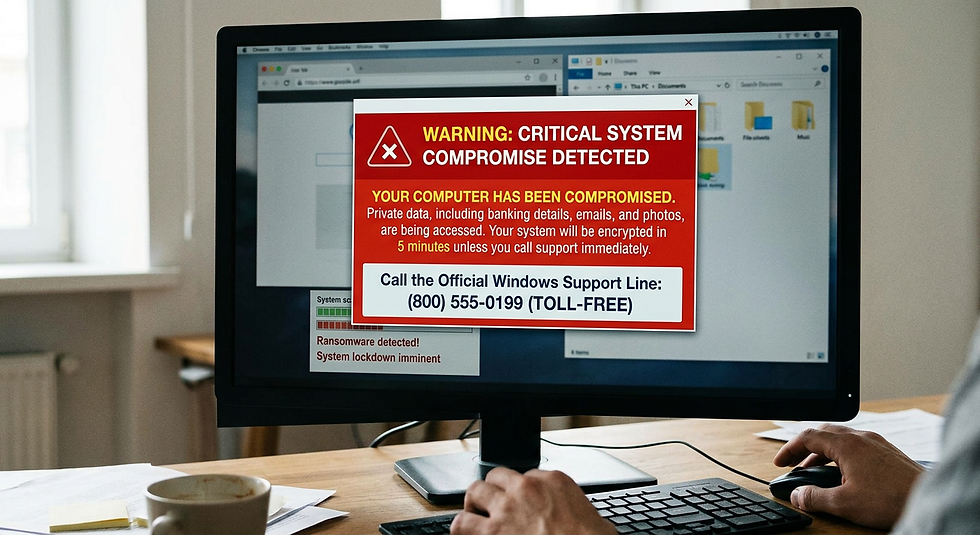
A family member runs a small business, and recently, she became the victim of a devastating social engineering attack. It started innocently enough: she clicked a link in an email. Her computer got infected, and suddenly, a pop-up appeared demanding she call a specific number.
What happened next wasn't just a technical glitch; it was a masterclass in psychological manipulation.
Over a series of conversations, the scammers convinced her not to tell anyone. They told her they were "investigating" a breach. They impersonated the Federal Trade Commission (FTC). They created a narrative so convincing, so urgent, and so isolating that she believed she was the only one who could fix it.
The result? She was convinced to send them a check for $35,000.
This isn't a story about a "stupid mistake." My family member is smart, experienced, and cares deeply about her business. This happened because the attackers didn't hack her computer; they hacked her mind. They exploited her desire to do the right thing, her fear of legal trouble, and her trust in authority figures.
What Is Social Engineering, Anyway?
Social engineering is basically psychological hacking. Instead of breaking through your firewall, attackers manipulate people into giving them access. They're counting on trust, urgency, fear, or plain old helpfulness to bypass your security.
Think of it like a con artist at a casino—they don't crack the vault; they convince someone to hand them the keys.
In my mom's case, the attackers used a classic combination of tactics:
Authority: Pretending to be the FTC.
Isolation: Telling her to keep it secret.
Urgency: Creating a crisis that needed immediate resolution.
Fear: Implying legal consequences if she didn't comply.
The Most Common Tricks Targeting Small Businesses
Based on what we're seeing in 2024-2025, here are the big ones:
1. Phishing Emails That Look Legit These aren't the obvious "Nigerian prince" scams anymore. We're talking emails from what looks like your bank, your cloud provider, or even your CEO asking for urgent action. With AI now generating convincing text, these are harder to spot than ever.
2. Business Email Compromise (BEC) Attackers impersonate executives or vendors to authorize fraudulent wire transfers. One small business lost $450,000 because an employee thought they were helping the CEO close a deal.
3. Pretexting & Impersonation Someone calls pretending to be IT support, law enforcement, or a government agency (like the FTC in my mom's case), asking you to "verify your password" or "pay a fine." They've done their homework—they know your name, maybe even your department.
4. Tailgating A friendly stranger follows you through the office door without a badge. They're not trying to hack your computer; they're just looking for an unlocked workstation or sensitive documents left on a desk.
Why Small Businesses Are Prime Targets
Here's the thing: Attackers love small businesses because we often have decent security but lack enterprise-level defenses. You're the perfect middle ground—not too easy, not too hard.
Plus, if you're part of a larger supply chain, attackers target you to get to your bigger partners. Your security becomes everyone's problem.
But the biggest reason? We want to believe the best. We want to believe that if we call the number on the screen, we'll get help. We want to believe that if we pay the "fine," the problem goes away. That's exactly what the scammers count on.
The Good News: You Can Fight Back
Perfect security doesn't exist, but effective security absolutely does. Here's what actually works, especially after seeing what happened to my mom:
🎯 The "Stop, Verify, Report" Rule
This is the golden rule. If you receive an urgent request—especially one involving money, passwords, or "legal trouble"—STOP.
Verify: Hang up. Call the official number listed on the company's website (not the one on the screen). Ask your bank directly.
Report: Tell someone. Never agree to keep a security issue a secret. If someone tells you "don't tell anyone," that is the biggest red flag in the world. My mom's attackers used isolation as their primary weapon. Break that cycle immediately.
🛡️ Technical Defenses That Help
Multi-factor authentication (MFA): Even if they get your password, they can't get in without your phone.
Advanced email security gateways: These filter phishing attempts before they hit your inbox.
Pop-up blockers and anti-malware: Essential for stopping the initial infection.
📋 Create a Culture of Safety
Make it okay to say "I'm not sure." If an employee feels pressured to hide a mistake, they won't report it until it's too late. Encourage transparency. If someone clicks a bad link, they should feel safe coming to you immediately so you can contain it.
The Bottom Line
Here's the counterintuitive truth: The shift toward human-focused attacks actually makes you more secure in the long run, provided you adapt. Traditional security focuses on protecting your systems, but these attacks compromise the people who use them.
Your goal isn't to prevent every possible attack—that's impossible. Your goal is to:
Make attacks significantly more difficult and expensive
Build resilience for rapid recovery when incidents occur
Preserve trust with your customers
Ensure business continuity
Ready to Take Action?
Start small this week:
Talk to your team about what social engineering looks like. Share stories like my mom's (without shaming).
Implement MFA on your most critical accounts.
Create a verification protocol for financial requests. No exceptions.
Establish a "No Secrets" policy: If someone is asked to keep a security issue quiet, that is a scam. Period.
Remember, cybersecurity isn't just about protecting data. It's about protecting your reputation, your customers' trust, and your ability to keep doing what you love—running your business.
Stay safe out there! 🛡️
Have questions about protecting your business?
Want more practical security tips? Subscribe for weekly insights on protecting your small business from evolving cyber threats.


Comments